HotDog and Sausage Software: the HTML editor that barked at the world
Table of Contents
The rabbit hole #
I remembered this weird HTML editor I used in the early 2000s: HotDog Professional. I was a kid reading about building web pages in computer magazines and wanted to try it myself. One of them recommended HotDog 6, which I downloaded as shareware over a 56k dial-up connection.
I liked it a lot. It probably didn’t hurt that it had a funny startup sound. At the time, it felt magical to put a page of my own out on the web for anyone in the world to see.
Going back to it after all these years was a nostalgia hit, but I had no idea I was falling down a rabbit hole. Three things struck me this time: what a forgotten giant the company behind it was; how much of what we do today it was already trying to pack into one program; and how much personality the thing had.
The dot-com darling #
Steve Outtrim wrote the first version of HotDog in 1995, in Australia. He was trying to build a personal page, but the HTML editors of the day kept crashing on him, so he wrote his own in Visual Basic and started Sausage Software to sell it. It took off quickly. By late 1996, it had sold 100,000 copies and sat on the shelves of thousands of US stores. It was in use at Microsoft, IBM, NASA, and Harvard, as well as AT&T and the CIA (named in the clip below).
That same year, Outtrim took Sausage public, at 23, making him the youngest CEO of a public company in Australian history. Wired ranked it the third most popular program on the internet, behind only the Netscape browser and the Eudora email client. At the peak of the dot-com boom, Sausage had more than 3 million customers around the world, over 1,200 staff, and a $1 billion market cap. Even Intel was among the investors.
It didn’t last. Outtrim stepped down as CEO in 1999 and exited just before the dot-com crash. The company drifted away from web tools into enterprise software and IT consulting. It soon took over an Australian IT-services firm and adopted its name, becoming SMS Management & Technology. To SMS, the web tools were non-core, and HotDog looked set to fade.
Except it didn’t, quite. In 2001, SMS sold the Sausage business back to a group from the HotDog team, name and tools and all. The employee-owned Sausage then said it had “returned to its roots,” added hosting and domain-name services, and released HotDog Professional 7.
Near the end, it was teasing a successor, “HotSocial 2009”, an “HTML editor for the Web 2.0.” It never shipped. The last archived page that still shows the Sausage site is from 2009.
The everything editor #
Digging it up #
What strikes me is how little of it is left online today, considering how ubiquitous this software once was.
In this post, I’m looking at the final version (7.03), released in 2003: its bloated peak. Sausage’s archived product pages for HotDog 7 (and 6) include the logos, mascot, screenshots, and sales pitch, if you want to take a look. There are also more screenshots.
I downloaded it from CNET, just like I did back in the day. It was one of the big shareware download sites, and to my surprise, it was still around. The free trial gave you the full version for 30 days, after which you were meant to buy a license. I installed it in a VM running Windows XP, the OS of its day, and the trial started up without a fuss.
The features #
At its core, HotDog was a text editor for people who wanted to write raw HTML by hand, or a “Web Editor” in the language of the day. Its tagline promised “Speed, Precision, Control — The Professionals’ Choice,” and the docs accused WYSIWYG editors (like FrontPage) of “hiding the HTML code from authors.”
It had much of what you’d expect from an editor today: syntax highlighting and code completion across HTML, CSS, JavaScript, ASP, and VBScript, with code folding and a live preview tab. Validation ran as you typed and underlined your mistakes. Hovering over a tag or attribute brought up a tooltip explaining it; hovering over an image got you a thumbnail. There were also 12 resource panels docked on both sides, including a point-and-click property sheet and a full tag reference that taught you the language as you went.
The property sheet marked which browsers supported what. Browser compatibility was a big hassle during the browser wars, when a feature might work in Netscape but not in Internet Explorer, or vice versa.
It bundled a stack of whole other programs: a visual CSS designer, an FTP client (Internet Files), an image editor (Image Lab), a browser that let you view the page at different screen resolutions, and a site manager (WebSites). Image Lab crushed graphics down to a size a dial-up modem could bear, showing the original and the result side by side. The WebSites panel kept track of the whole site: publishing only changed files, hunting down broken links, locking files so two people couldn’t clobber each other’s work, and keeping per-page to-do lists with due dates and assignees.
Then came the small army of wizards and dialogs, 16 of them, one for nearly every construct that felt hard at the time: frames, forms, tables, image thumbnails, DHTML animations, Flash embeds, page transitions. The Document Properties dialog estimated how long your page would take to download at various modem speeds. A plugin system (SuperToolz) brought in extras from Sausage’s own add-on store (AutoDownloader). It came with the full HTML and CSS reference manuals, plus its own user manual.
The built-in tools reached well past HTML editing: SQL table and query builders, an HTML compressor, a CHM converter, a site mapper, an image mapper, and more. SuperToolz leaned even harder into its moment, with wizards for LinkExchange, ICQ panels, Java applets, RealAudio, and SMIL, plus Xara 3D and Intel’s media kits.
Everything to everyone #
Outtrim described HotDog as “almost entirely written by the end-users” because he built whatever the users asked for. The openness that made HotDog successful is what bloated it. Newer users found the program overwhelming, and the team’s own diagnosis was that they’d been “trying to be everything to everyone.” There’s a name for this pattern. Zawinski’s Law states:
Every program attempts to expand until it can read mail. Those programs which cannot so expand are replaced by ones which can.
The point isn’t really about email. It’s that the apps you live in all day come under pressure to do everything: an editor becomes an IDE, then something close to an operating system.
Sausage’s approach was “family planning,” as they put it: HotDog Junior for kids and the WYSIWYG editor PageWiz for novices. Pro stayed as it was, for the professionals. So they built the very thing the Pro docs had accused of hiding the HTML code.
The funky stuff #
A program that barked at you #
“We’ve got programs that bark and growl at you,” the company’s homepage said in 1996. Startup and shutdown played little bursts of funky music, full of howls and barks, and opening or closing a file got you a bark each time. The installer even pitched them mid-install: “HotDog comes with cool sounds. Would you like these turned on by default?” Who wouldn’t want that? Woof!
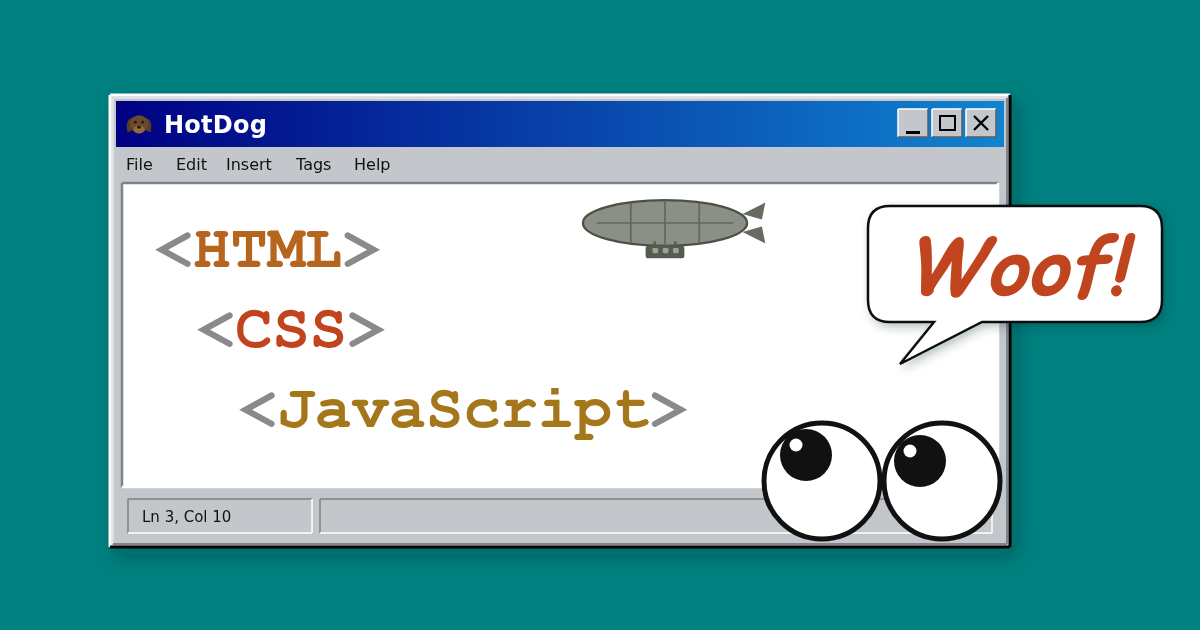
The mascot, “Ganster” (not gangster, mind you), was presented in the company’s branding guide. He’s a green dog in a black suit, hat, and shades, standing behind a guitar case that held <HTML>, <CSS>, and <JavaScript> where the tommy gun should be. He turned up everywhere: on the splash screen; in a pointed hat, wand in paw, guiding you through every wizard; and hauling your files across the screen during an FTP upload. The company’s own logo was something else entirely: the “Silver Sausage.”
The status-bar Easter egg #
The Easter eggs are the real treasure. I remembered, very vividly, a pair of eyes that lived in the bottom-right corner of the editor and tracked the mouse cursor (the same gag as the X Window System’s xeyes and Google’s “googly eyes”). A tiny thing tucked into the status bar.
That corner ordinarily shows the caret’s line and column. Right-clicking it opens a hidden menu. It starts innocently, with readouts for the date and time, memory usage, and even the local time at Sausage Software. Below those come the jokes: the “Eyes,” a trippy color-cycling version of them, and a scrolling set of developer credits (“Random Comments”). The scrolling credits pull from 12 developers, each with a nickname and a comment. The ones I could make sense of are “This is more fun than work,” “SuperFast SuperOptimized,” and “How did I get HERE???” Four special thanks turn up in the mix, including one to “HotDog Great GrandPappy Steve Outtrim” and one to the forum regulars who tested the pre-release versions.
The remaining two readouts are really jokes in disguise: a “HotDog Team BAC” meter (blood alcohol content) and a “World Population” counter frozen at its 1998 figure, apparently broken by the decades since. I caught the BAC meter just over the Australian drunk-driving limit, and lower on another run, so it may well be tied to the clock.
The Quote Gallery Easter egg #
Poking around further, I stumbled onto another one: a gallery of office in-jokes buried in the Format Paragraph dialog. Its ordinary preview text is already a gag, a line of Dr. Evil’s monologue from Austin Powers: “he would make outrageous claims like he invented the question mark…” The actual gallery only appears when you hold Shift+Alt and right-click the dialog’s list of style categories (the left pane). It’s basically a slideshow that plays inside the preview box on the right, advancing to the next slide with each further click.
“The Quote Gallery” stars the same developers as the scrolling credits. The whole thing reads like a scrapbook of office chat logs smuggled into the product: some wild exchanges and, out of nowhere, “Zeppelins - Ships of the Air. We just can’t get enough of them.” One developer who “disapproves of this sort of thing” gets a “special hello.” One slide is pure noise (“d’arghhghghghghhhhhghghgh”), one waves “G’day to the old HotDog boyz,” and the last one signs off with “Now returning to your regular viewing…”
The gallery also has a live link to “POKEY THE PENGUIN!!!” (an absurdist MS Paint webcomic running since 1998) and a couplet from The Call of Cthulhu by H. P. Lovecraft, the 1920s horror writer who invented a pantheon of ancient, indifferent, godlike beings: “That is not dead which can eternal lie, and with strange aeons even death may die.”
A streak of the surreal #
It isn’t just the hidden stuff. The same taste runs through the documentation, in plain sight. The demo page meant to teach you framesets is a little fan shrine to Hieronymus Bosch, the late-medieval painter of hellish, monster-filled altarpieces. A tutorial on FTP publishing uses, as its worked example, a webmaster uploading a website about Lovecraft’s Cthulhu. The tutorial’s example folder tree is filled the same way. Azathoth, another of Lovecraft’s gods, sits right next to Bosch. Borges, who wrote of infinite libraries and forking labyrinths, is filed under Writers. They Might Be Giants, the cheerfully oddball duo behind accordion-driven songs about self-narrating nightlights and Particle Man, is placed under Music. These references and similar ones recur in other help pages as well.
Funk as company policy #
The funk spilled out of the program, too.
The marketing swagger #
Before HotDog 7’s tagline of “Speed, Precision, Control — The Professionals’ Choice,” HotDog 6 was pitched as “The Gun Coder’s Solution” (“gun” being Australian slang for an expert) and “The Secret Weapon For The Crack-Shot WebMaster.”
Their marketing resources provided banner ads with hard-sell one-liners like “HTML, huh? We eat it for breakfast,” and another that jabbed at rival HomeSite as an imitator by renaming it “HomeDog.” There was also a sheet of 88×31 buttons for fans’ own pages (“HotDog Now!” winking at “Netscape Now!”), and a James Bond-style gun-barrel intro. A “gun” coder, after all.
The Funkometer #
Sausage’s homepage had a “Funkometer,” a little icon in the corner for cranking the site’s funkiness up or down.
The backstory: a redesign had traded the old “flamboyant” look for something cleaner and, Sausage admitted, “sacrificed the fun, dang it.” The Funkometer patched the fun back in. It offered a ladder of funk levels from 0 (“Lame, boring, and motionless”) to 6, and saved your pick in a cookie. Each step up added more: plain image rollovers at the bottom, hover sounds above that, then wild bouncing navigation menus, and at the top the Sausage Shockwave Dog. The web team rendered 30 angles of the mascot dog’s head in 3D Studio Max and wired them up in Macromedia Director so that the head turned to follow your cursor around the page. It’s the status-bar eyes, scaled up into a whole mascot.
Sausage Island #
Sausage Island was the tropical-themed community corner of sausage.com, and it was where the company gave its stuff away. Pride of place went to Reptile, a generator for the wavy tiled page backgrounds that were everywhere back then, offered “just to show our appreciation for the networks of millions of pages that we collectively call the ‘Internet.’”
The rest was pure funk: a “wacky” Sausage screensaver, a psychedelic Reptile screensaver that promised to “keep you in a trance for hours,” and a “Galleria” of Shockwave games you could play or drop onto your own site.
The crew #
Sausage’s website had a Who’s Who page in 1996: a card for every one of the roughly 50 “crew members.” The company happily let them run personal homepages however they pleased while pointing out that the pages were “uncensored and ungoverned by any company policy” and warning you about “outrageous, rude, politically incorrect and otherwise offensive views.”
The company’s homepage noted that tech support had “taken to unusual footwear,” Big Bird slippers and Monster Feet among them. They even pointed a live webcam at the reception area, showing a fresh snapshot on the homepage every 30 seconds. A crew member’s page remembered the office for “foam frisbee wars, pinball and pool sessions, late-night pizza runs and general mayhem.”
What’s left #
I started this as a nostalgia trip and ended up doing archaeology. Richard Feynman said that “nearly everything is really interesting if you go into it deeply enough.” A long-dead shareware HTML editor turns out to be no exception.
I couldn’t find any of the funky stuff on Google: not the barks, not the status-bar gags, not the Quote Gallery, not the Funkometer. Nor the employee-owned Sausage. AI doesn’t know it either (at least until this post gets scraped).
Where the features went #
Almost every feature is still around 23 years on, just not inside the editor, scattered across separate tools that each do the job better: VS Code and its extension marketplace, Chrome DevTools, Squoosh, caniuse.com, MDN, Git, GitHub Issues, axe, Lighthouse. A few haven’t aged the way you’d expect.
HotDog integrated accessibility checks into the editor with version 6 in 2000, right after the W3C’s first guidelines in 1999. More than a quarter-century later, the 2026 WebAIM Million survey still finds accessibility failures on 96% of the top one million homepages. The download-time estimate has aged just as well: page weight keeps going up.
For all its bulk (editor, image editor, FTP client, site manager, wizards and all), HotDog ran in about 45 MB of memory from an 11 MB download. By comparison, VS Code needs a download of more than 100 MB and well over a gigabyte of memory in everyday use.
Where the web went #
HotDog belonged to a web you made yourself. You hand-wrote a page, opened the FTP client, and dragged it up to a hosting space that was yours: a university account, an ISP’s free megabytes, a GeoCities homestead. You linked out to whoever you liked, joined a webring, put a button in the footer. Nobody sat between you and your visitors, just as Tim Berners-Lee intended.
Most people’s presence online now sits inside a handful of “walled gardens,” where you fill in someone else’s template and reach whoever the algorithm allows. That’s worth resisting (the IndieWeb is one attempt), but it’s also easy to romanticize what they replaced: the independent web asked something of you, a little HTML and somewhere to put it, and most people never cleared that bar. Yahoo shut GeoCities down in 2009, the same year sausage.com went quiet.
Where the funk went #
None of it had to be there. The barks could be muted (“HotDog Sound FX” in preferences), the Easter eggs took some digging to find, and no review would ever score the Funkometer. But it says something that after all these years, what I remembered wasn’t the wizards or the dockable panels. It was a pair of eyes in the corner, and of course the barks.
Where did all this go? Partly, software grew up. The cartoon-mascot age of Clippy, BonziBuddy, and the Sausage dog gave way to flat wordmarks, and big shops like Microsoft banned Easter eggs once undocumented code came to be seen as a security liability. You can see the same thing happen inside Sausage: the Who’s Who page disappeared after it became a public company, and the Funkometer was already an apology, fun bolted back onto a redesign that had “sacrificed” it. A status-bar gag about the team’s blood alcohol wouldn’t survive a modern design review. The funk didn’t scale.
I’d bet the other versions of HotDog hide Easter eggs of their own, and so does plenty of other software from that era, waiting for someone to go digging. It makes me wonder how much of this stuff was never found at all, or was found once and then lost again with the forums it was posted to.